Full Autropa Design Document (Google Drive)
This is by no means an exhaustive list of all the countries, territories, regions, etc. that can be found around the world of Autropa. For the initial campaign, twenty separate territories were created, including the Goblin Wilderness and the mysterious Wizard Isles (the latter do not appear on any maps, currently, but correlate to Sardinia and Corsica here on Earth).
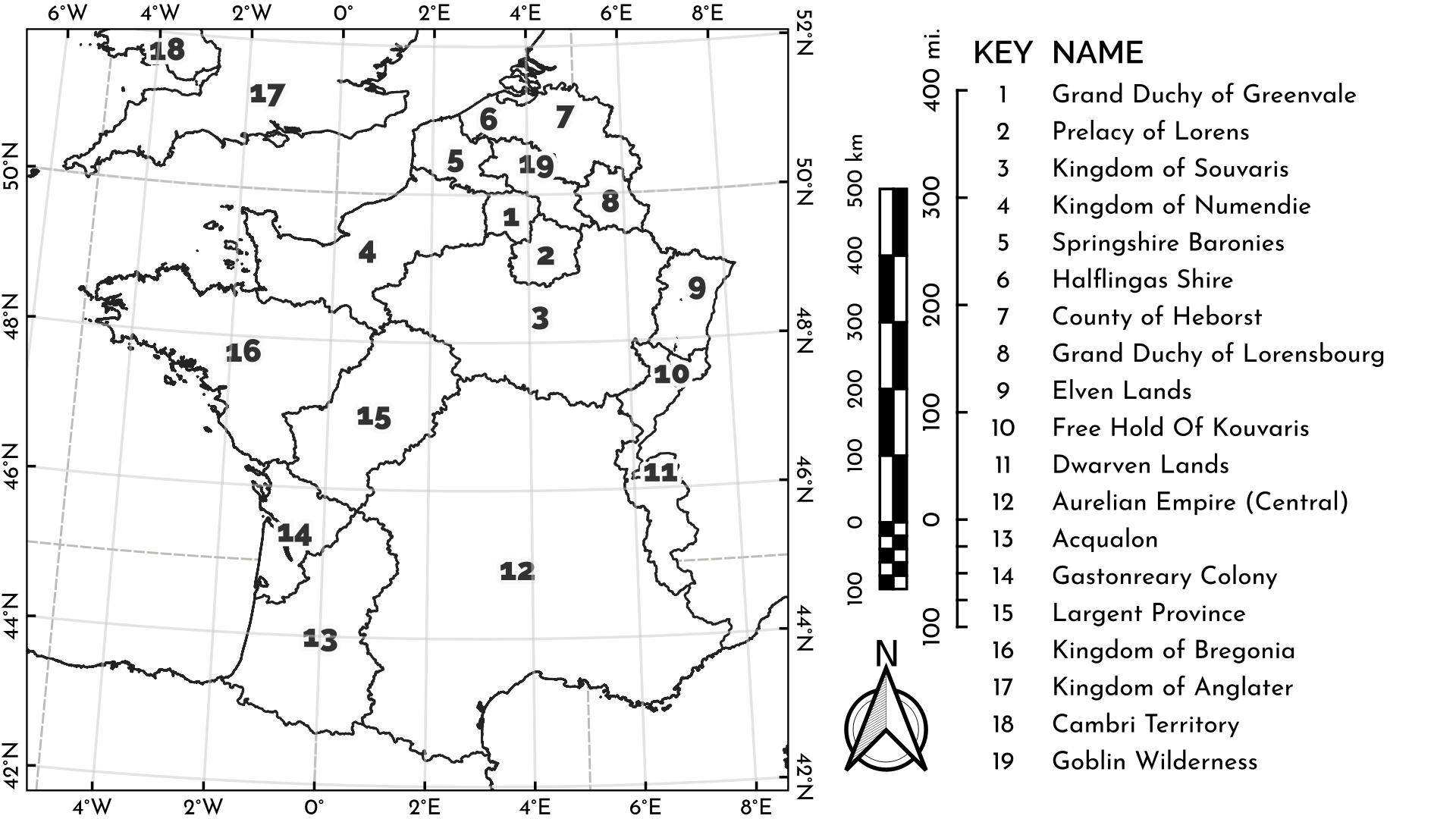
Above: A map of the various polities involved in the current campaign.
1.Grand Duchy of Greenvale
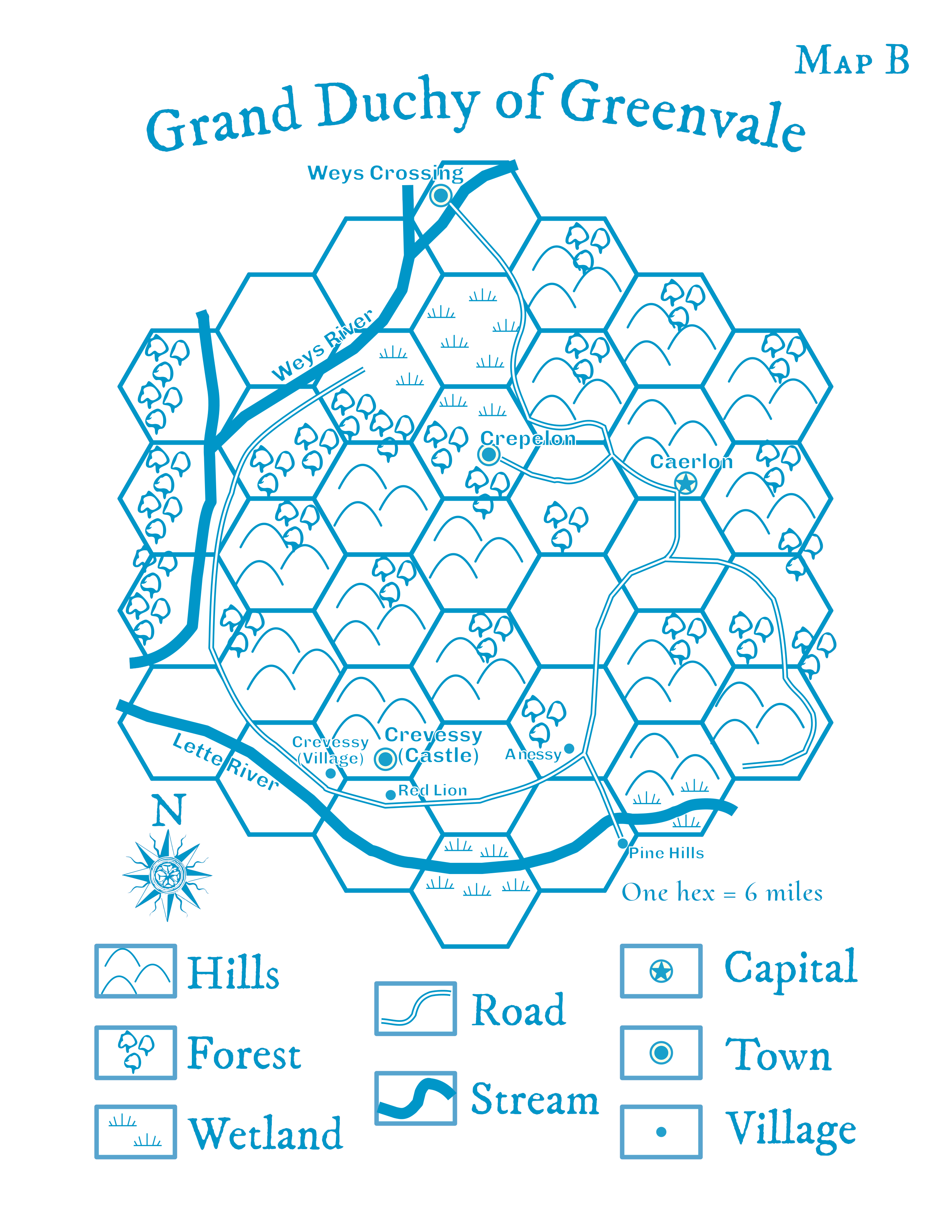
Above: A generalized map of the Grand Duchy
This independent state is ruled by the Grand Duke; however, a large portion of the political power in the country is shared with the current Patriarch or Matriarch of Lorens, which is the title of the second highest rank within the Church of Lorens. At present, the Matriarch of Lorens is also the sister of the reigning Grand Duke. The Grand Duchy took the appellation Greenvale upon obtaining its independence from the Kingdom of Souvaris, around 120 years prior to the start of the campaign.
Before becoming a sovereign state in its own right, the region was composed of various estates, with about a third of it as part of the Duchy of Crevessy. The current Grand Duke is a member of the Crevessy family, although his name is Thomas Abmarle; he continues to use the title Lord Crevessy, at least when operating within his own demesne. The Grand Duke rules from the castle town of Crevessy; upon gaining independence, then, Lord Crevessy had a new castle built over the remains of an older fortification. The current Castle Crevessy is the largest, and most heavily fortified castle in the entire Middle Lands; however, the territory’s capital is the city of Caerlon, which lies approximately 20 northeast of Crevessy (castle and town).
Greenvale is a fairly powerful military state, with a standing army of around 1500 troops. The size of the standing army is smaller than that of either the Kingdom of Anglater or the Aurelian Empire; however, the Grand Duchy has the only dedicated war college in the Middle Lands (N.B. the Aurelian Empire has institutions of higher learning that would include military science, etc., but they are not specialized in that area). The standing army is organized into three Divisions (Cavalry, Infantry, and Engineering); each Division can be further subdivided by Company, Platoon, and Squad. The army is led by a Colonel, a Major, three Captains, and 15 Lieutenants; additionally, there are non-officers with leadership responsibilities, including: five Staff Sergeants, 15 Sergeants, and 60 Chosen Men (roughly equivalent to what might today be called a Lance Corporal).
Most villages in Greenvale will only have a fraction of the necessary services available to the local farmers; however, most villages occur in clusters that can, collectively, satisfy most of the goods and services required by rural farmers. While the major walled towns of Greenvale will hold markets once or twice per month, the typical farmer only goes to the town markets a few times per year; often, rural farmers will only go to town markets at times of major fairs and festivals, unless they have a specialized need that can only be met at one of the town markets. Outside of market days, even being in a major market town is no guarantee of being able to find any particular good or service from one of the usual merchants. Since the merchants of the walled towns generally produce for major organizations like the army (Crevessy), the Church (Caerlon), and the mining/smelting/blacksmithing industries (Weys Crossing), the merchants are not always free to work on outside projects. When possible, it is a good idea to hire skilled craftspeople directly, rather than to expect a shopkeeper will be able to accept a personal project.
2. Prelacy of Lorens
This independent state is governed by the Prelate of Lorens, the highest religious position in the Church of Lorens. There is a noble class; and, it is from the nobles that the orders of knighthood are drawn. Of particular importance are the Order of the Golden Ram, an organization of paladins that serve as the command structure of the military. Merchants and tradespeople do have some semblance of higher status in cities/walled towns. The influence of the Church is present in all facets of daily life for the residents of the Prelacy.
There is a good deal of traffic between Caerlon, and the Prelacy of Lorens, especially its capital of Ransa. Many of the natural resources are the same, and available in similar amounts, between the Prelacy and Greenvale; so, the traffic between the two polities tends to be commerce in ideas, especially religious thought, and finished goods. Both Greenvale and Lorensbourg are considered especially devout polities, on the whole; so, they receive more contact with the Church of Lorens’ leadership in the Prelacy.
3. Kingdom of Souvaris
This kingdom was the parent state of the Grand Duchy of Greenvale, the Prelacy of Lorens, and the Grand Duchy of Lorensbourg. The kingdom was, also, one of the land donors when the Free Hold of Kouvaris was established. The Kingdom is considered fair, and just; most residents live in villages, and are considered free people. The southern part of the Kingdom has issues with attacks from Girovian rebels operating over the border.
The dominant settlement pattern is that of most Souvarin lands, although pretty much all farmers live on discrete farmsteads, arrayed around small villages. As with elsewhere in the Souvarin lands, each village will only have some many specialized craft services available; but, any given cluster of villages will, generally, have most goods and services available, at least those that would be in high demand in rural farming communities.
4. Kingdom of Numendie
This kingdom was first established by people from the Northern Lands. The settlers of this region are from the same general source area as groups who had previously emigrated from the Northern Lands, and who became part of the Kingdom of Anglater. They later won their independence, and have long been a stable and respected state. They are, currently, on friendly terms with the Kingdom of Souvaris; they are at peace with Bregonia, and have guarded relations with both the Springshire Baronies, and the County of Heborst. They maintain diplomatic connections with Anglater, but the Kingdom of Numendie is still regarded as something of a breakaway state by Anglater.
5. Springshire Baronies
These territories are subject to the Kingdom of Anglater. There is a variety of different territory sizes, with a wide range of annual productive values. Noble domains tend toward the lower end, primarily Barons and Earls, but also knights that have been granted a small domain of their own. These lands were the scene of some of the fiercest, deadliest fighting of the Kingdom Wars; much of the Baronies’ southernmost territory was gained during that period. The Springshire Baronies are very much a martial territory, and highly feudal in structure. Each of the lords must maintain troops at the expense of the household. They have been known to have petty wars among themselves, periodically; their estates pass through heredity, although social positions may change. Each of the barons, earls, counts, etc. are embroiled in an ongoing series of political manipulations, internally and thorough relationship with other states. Quasi-military uprisings breakout occasionally; these are mainly instigated local veterans fighting against corruptions in the local system. They are all, also, vying for influence with Anglater.
6. Halflingas Shire
This small territory was secured by elvish interference in the military affairs of the various human-dominated states in the region. It is an independent enclave within the County of Heborst; it has no political connection with Heborst, and most people in the region believe that a free halfling state only continues to exist due to pressure from the elves.
The halflings, typically, remain inside their Shire; they are, primarily, an agricultural people. They have seasonal festivals throughout the year, and much dancing, drinking, story-telling, gossiping, and even some politicking is done during those times. Halfling farmers sometimes sell their produce at human market towns. Some halflings leave home to live in the Free Hold of Kouvaris; these halflings tend to live among humans, and in similar housing.
7. County of Heborst
This area, which was formerly an independent human-dominated state under the protection of the elves, is currently a possession of the Kingdom of Anglater. There is still a portion of the people, especially in the southeastern part of the County, that are strongly connected with the elves. Many of the “elf friends” become Rangers, and spend time patrolling the borders of the extensive elven forest. However, most of the County, and especially in its densely populated capital city, is strongly Anglaterian in orientation. The County produces coal that is used by the dwarves, and some human metalworkers.
There is still a majority of about 65 percent Hebortians living here, with about 30 percent of the rest being Anglaterian. The Anglaterians hold the highest offices, while the Hebortians are relegated to subordinate ranks. In the southern part of the County, many of the native Hebortians still have regular contact with the elves; this borders on being a secret society, as far as the Anglaterians are concerned (known as the Order of the Green Branch, or the Green Branch Society).
8. Grand Duchy of Lorensbourg
This independent state was created out of the original territory of the Kingdom of Souvaris. The population includes both Souvarins and Kouvars, which are historically related groups with a common language, and common culture core. The Kouvars were, historically, more inclined toward diplomatic ties with the elves; this is the major difference between the two groups, but it is a very old division (N.B. there was also a third group, the Suevars, but they fought their way to a new land in the south).
The Grand Duchy of Lorensbourg is very similar to its counterpart, the Grand Duchy of Greenvale. The Grand Duke keeps a much smaller army (perhaps 650 permanent troops); however, the Church of Lorens is a much more martial organization, and supplies an nearly equal number of warrior priests, plus some more martial monastic orders.
19. Goblin Wilderness
This is not a polity in itself; however, goblins, hobgoblins, and bugbears are the most numerous inhabitants of the region. The goblins are actually subjects to a hierarchy of giants. The region is not entirely composed of monsters; there is a sizable population of gnomes living along the Somber River valley. It is a dangerous terrain, with everything from kobolds to giants; and, yeah, a lot of goblins. The Goblin Wilderness will definitely factor heavily in the final adventure arcs of the first campaign. While this region is teeming with monsters, including large monsters that more more rare in the settled areas, that does not preclude meeting with friendly, even helpful, entities.
|
< Autropa Setting > |

